Monday, February 13, 2012

Gilani Gravity Lessons

From his wife’s multi million loan waiver, to his son’s alleged involvement in Hajj scandal. From friends and family involved in massive corruption cases to almost ritualistic shuffling in bureaucracy, hampering court investigation into several legal cases, the list goes on and on…

…bottom line… his blood group is “corruption +ve”.

Transferring high profile government officers at free will, to disrupt legal investigation into several matters of national importance, ranging from Hajj Scandal, Fertilizer scam to Swiss cases, there is a pattern to Gilani’s defiance towards rule of law. Still he totally gets to brag about his respect for Law by merely presenting himself to Supreme Court, once he is summoned there.

That’s ridiculous!
Its like, I respect you dad, but who gives a rats ass about what you ask of me, Huh !

He earlier indicated that memo case might lead to his ousting. Later he gathered courage and defiance over the matter, only after entire state machinery came out of the closet, hell bent to not allow and threaten the primary witness to the case, Mansoor Ijaz. Gilani even declared Army chief’s request to the apex court for independently probing into Memo case, an “unconstitutional and illegal” act.

According to a letter submitted to Supreme Court earlier this week by Gilani’s lawyer, he mentioned reinstating the judges of Pakistan to his list of services for judiciary. Yeah right!

Only if the people in this country received a daily heroin dose through some public ration program, that we would forget a massive Long March towards the capital which forced Gilani to announce the restoration of judges around 5:30AM early Monday morning of 16th March, 2009. Not mention the entire state machinery, police blockade, house arrests of several leaders, and ceasing of roads from entire province of Sind, was applied to stop the public from reaching Islamabad.

In his haphazard address restoring judges of Pakistan, b*****d goes onto say, “today I fulfilled the promise of Late Benazir”

Hello?

Army had refused to intervene, there were millions of people on roads, driving in huge convoys about to reach Islamabad any hour and, and a*****e gets to brag about his gift to Nation. Humph !

This dangerously shameless attitude of not learning from his mistakes is the reason why we worry for our country most.

Such is the intellectual meltdown of our ruling class and their followers, that it is almost sickening to allow their daily statements into even the most corrupt portions of one’s brain. I would rather see somebody shoot a cat, set it on fire or feed it to crocs, than allowing myself to watch his hollow public speeches and shameless self defense. Self acclaimed champions of democracy, with absolutely nothing to blame for shortcomings than their own; either stupidity or evil intentions.

I have high hopes for our collective national future, but I am Hopeless with Gilani. Regardless of him being convicted by Supreme Court today or not, I am sure even the gravity would fail to teach any lessons.

NOTE:

I felt the need to start a blog, because there were things I could not say in radio shows. Essentially ethics of broadcasting wouldn't allow me.

When did I first feel the need?

Well minutes after watching Gilani’s first address to Nation
You can (should) read my first ever blog post at:

Breaking Ice


Wednesday, January 25, 2012

Flying my Space, Killing my people.


[ News Item: Shoot down US drones, urge lawmakers in Pakistan.]

If you are single, it doesn't mean you are as young as you once were. I have to admit that I often force myself into younger crowd, just to be able to draw energy from their spirits. Honestly there is not much gap, only if I leave behind the wisdom of my older folks.

Here is the excerpts of a brief conversation with an Engineering student from Karachi.

"How is love life?" I asked, since I heard engineering students have usually dry campus life.

"I am flirting with something" he replied in wit.

"some'body', right?" I smiled to cover my invasive curiosity.

"Nobody! Its an 'idea'", he sparked firmly.

Before allowing me a pause for even a gesture he continued

"You understand science behind photo cameras?"

"hmmmm" I honestly intended to signal my discouragement for any further discussion on photography. Talk to me lakes, mountains, birds and butterflies said my inner voice but instead I snapped a quick one right from my heart to him, "you go to parks?"

Perhaps it was due to a recent television episode which is currently enjoying word of mouth of youngsters, which influenced my line to get this young man into grove.

He understood my intentions.

His face blushed, as he wearing a pure and genuine smile, covered in a natural blanket of shyness stressed to me again...

... "so i am flirting with this electronic and digital technology behind lenses of modern cameras".

Reading face is a myth, since mine said "Bite me!".

His subtle tone had more conviction than excitement this time, as he said;
"Did you notice the automatic face detection feature of new cameras?"

A totally new dimension of a young engineering student's romance had unveiled itself.

I could instantly recall one such boxes appearing on my camera screen, though I have turned the feature off, lately.

But my friend's latest camera shows as many number of boxes, as there are faces in a snapshot.

I remember saying "wow" as I kept sinking into the deep pit of this techno-fascination.

Visualizing my university instructor from Digital Computer Logic course, I fancied the programming code that must have been written, in order to perform this function.

Right at the moment, when live video feed is being played on the Camera's LCD screen, a fascinating programming code in computer language enables an electronic camera to also behave as a facial sensor.

With complete grasp of this technological invention, and having not paused earlier to completely admire it, I was compelled to wear a natural facial expression of 'wonder' and 'amazement'.

By now the myth of face reading, was also busted :)

I could only say "Fascinating" since I truly was.

He sucked me in completely by asking, "when a digital camera lens can be programmed to detect a face, would it be any harder to detect a flying object, lets say an unmanned flying predator or drone planes?".

"Its both simple and cheap" he nailed it.

Now my disfigured eyebrows did all the talking, as I rubbed my hands and bent close to quench the thirst of my creative curiosity, while he fell his back straight and said...

"Such a small chip and lens can guide any missile automatically to target those, Flying our Space, Killing Our people!"


Monday, January 23, 2012

Dangerous Ideas

According to the only "one liner" used in the promotional trailer of "WAAR", an upcoming Pakistani movie ; "we here in Pakistan don't resent deaths of Pakistanis". Despite the fact I strongly oppose the statement, but here I don't wish to debate a mere cinematic jugglery of words.

I being a radio broadcaster for almost 8 years in the most populous city of Pakistan, have a rare opportunity to keep a track on the pulse of the nation. My observation allows me to declare that; we as a nation are definitely saddened and shocked to see the entire array of crimes, available through the various spectrum of news and media. But what bothers many in the country is the lack of justice and anti-corruption measures and machinery put in place to ever stop it.

With the media projection of high profiled and celebrated cases of corruption nominating power centres as big as president himself, the hunger among the masses to see the judiciary above everyone else, is growing in parallel too.

Recent summoning of Pakistani Prime Minister in Supreme court, regarding re-opening of corruption cases against the President is a fresh episode. Media's singular focussing lenses magnified the issue for the Nation. Prime Minister walked in and out of court, waving the legislative clause from the constitution of Pakistan providing the President complete immunity from being trialled. The constitutional immunity doesn't drop charges of corruption against him, but only acts as a defence line between him and the accountability of Law.

During a radio talk show this week, a caller called in live from Karachi. He wanted to relieve his friend from a civil law suit filed against him. His friend's name was Sadar Uddin, who lived in Sadar area, and was President (sadar) of his apartment welfare association. He apparently lost a file of the association, and thus faced charges of misconduct.

At this point the idea floated by the caller (Sohail) was more shocking than amusing, to listen.

Have a listen:

[ more on shoaibincontrol ]

If Sadar (President) is above law, than what about someone who is thrice a Sadar. It could be a joke, but since you heard, the caller didn't like the idea of me laughing and demanded strict seriousness to his concern. That is indeed a shocking attitude.

When we see bloodshed and crime, it only saddens us for a day. But injustice prevailing afterwards, takes away our hope for a better future. It is in this climate that the, dangerous ideas are created and passed on to masses.

For God's sake there be not a; soul above law!

Friday, December 30, 2011

Year 2011


This year like any other before it, was full of events which helped change the world which know of.


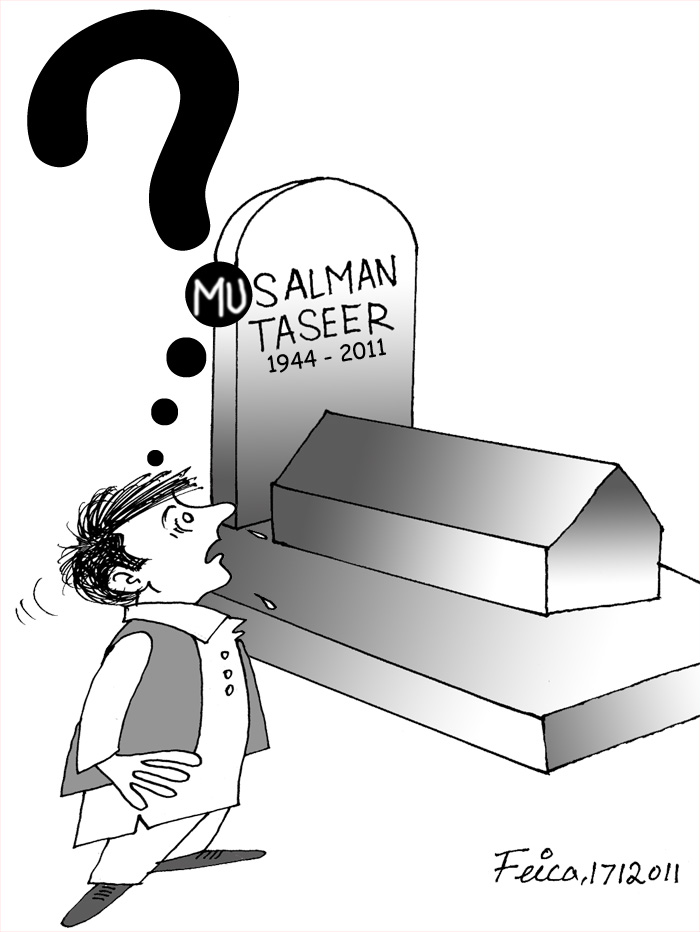
January 4, 2011 Salman Taseer (aged 66) was assassinated in Islamabad by his own security guard Mumtaz Qadri. In an interview with Meher Bukhari on Samaa TV, Taseer commented on his view about the country's blasphemy law which came under fire from different sections of Pakistani society. In the aftermath of his death, a sharp contrast between the ideological division of Pakistan society became apparent. Some called off a Fatwa against attending his funeral and hailed his assassin as a hero. The other group reluctant of expressing their sympathies parted their ways. I rang phone to a personal friend of late governor for condolence and was shocked by the attitude I received.

25 January 2011
Egyptian revolution started
movement began on Tuesday, 25 January 2011 .The uprising was mainly a campaign of non-violent civil resistance, which featured a series of demonstrations, marches, acts of civil disobedience, and labour strikes. Millions of protesters from a variety of socio-economic and religious backgrounds demanded the overthrow of the regime of Egyptian President Hosni Mubarak, who was ruling for more than 30 years.

Despite being peaceful in nature, the revolution was not without violent clashes between security forces and protesters, with at least 846 people killed and 6,000 injured. What started symbolically in Tahrir Square of Cairo, quickly spread to Alexandria, and in other cities in Egypt. On 11 February, following weeks of determined popular protest and pressure, Mubarak resigned from office.

On January 27, 2011,
Raymond Davis
killed two men in Lahore, Faizan Haider, 22 years old and Faheem Shamshad 26 year old. Davis turned out to be a former United States Army soldier, private security firm employee, and contractor with the Central Intelligence Agency (CIA).


The U.S. and Pakistani governments did not agree as to Davis' legal status in Pakistan at the time of his arrest. Claim of him having a diplomatic immunity was denied by the Pakistani authorities. Overnight media coverage turned Davis into a household name throughout Pakistan, and his case was closely monitored and reported. Just when diplomatic efforts from US were appearing to eye any successful in persuading Pakistan for his release, one of the victim; Shamshad's widow, Shumaila Kanwal committed suicide and last words she uttered reflected her hopelessness for any justice be given to her. Pakistan's then foreign minister Shah Mehmood Qureshi also paid a price for denying American claim of Davis' diplomatic status. On March 16, 2011, Davis was released after families of two killed were paid $2.4 million blood money.


11 March 2011, Japanese Earthquake made headlines around the world. Earthquake of magnitude 9.0 approximately 70 kilometres east of the Oshika Peninsula, hit underwater at depth of approximately 32 km.


This also resulted in massive tsunami, which further caused destruction on a second level. The Japanese National Police Agency confirmed 15,844 deaths,5,890 injured, and 3,451 people missing across eighteen prefectures, as well as over 125,000 buildings damaged or destroyed. Around 4.4 million households in north-eastern Japan were left without electricity and 1.5 million without water. Japan declared a state of emergency following the failure of the cooling system at the Fukushima Nuclear Power Plant.

It crippled transportation, destroyed telecom, dams and water, ports, disrupted electricity and gas, and effected Japan's defence and space program. World Bank's estimated economic cost was US$235 billion, making it the most expensive natural disaster in world history. Despite international media and relief workers were not allowed in the country, what we saw was long cues of Japanese people patiently standing to receive basic stuff like water. The courage with which the nation lifted and emerged out of this tragedy, was the most spirited lesson learnt from this disaster worldwide.

22 April 2011 Moin Akhtar
(aged 60) was a Pakistani television, film and stage actor, as well as a humorist, comedian, impersonator, and a host. He was also a play writer, singer, film director and a producer.

We have grown up following his comedy on TV and stages. Akhtar was fluent in several languages, including English, Bengali, Sindhi, Punjabi, Memon, Pashto, Gujarati and Urdu. His fan following spreads throughout the subcontinent and his demise was followed by a national mourning.
His took off from the ever declining stage comedies of 80s & 90s and parted his ways from another comedian Omar Sharif, only to emerge as an iconic talent with a taste for meaningful satire and rich subjects. His legendary place in the entertainment industry of Pakistan, will always be felt with a huge vacuum left till eternity. He was a heavy smoker and died in Karachi after suffering from a heart attack.

May 2, 2011, Monday, Osama bin Laden
(aged 54) was reportedly killed in a US forces special operation, carried out in Abottabad. The news sent a shock wave throughout the world, but ripples it most created was inside Pakistan. Who? What? How? that followed, continued to spray onto minds of almost all citizens for weeks to come. Notably there were more questions left than answers, amid this saga. Osama was buried in sea within hours, and no visual picture of video is produced till date to confirm. Since American president announced the news instantly, Pakistan was only hoping for a peace to follow after the demise of their more feared enemy. Once again several absentee funerals were also reportedly prayed throughout Pakistan.

22 May 2011 PNS Mehran was attacked by militants carrying guns, rocket-propelled grenades (RPG) and hand grenades, killing 13 people, injuring 16 others and blowing up at least two military aircraft.

The dead include 11 navy officials and one Ranger, while two P-3C Orion, maritime patrol aircraft were destroyed within first few minutes of the attack. Not only live footage ran through most the news channels, but also live sounds of gun fires and explosions could be heard throughout the night in many nearby areas of Karachi. It took 14 hours for the security force to finally clear the base of militants. Preparation and tactics of the terrorist was acknowledged by the Naval chief.


(Continued....)

Sunday, November 27, 2011

Have some Respect !

Do not brag about the size, unless your gun comes with balls.

Tuesday, October 25, 2011

Your Villain My Hero


We grew up in an age of wars and global conflicts. Foreign diplomacy weighed by either international assistance or isolation. Where military maneuvers and political alliances go hand in hand.

Old folks tell us about times when there were initiatives drawn on common global interests and ideological identities. Those were times of Zulfiqar Bhutto in my country, King Faisal in Saudi Arabia, Anwar Sadaat In Egypt and Colonel Gaddafi in Libya.

Those were days when these men aspired their people with euphoria from an uncharted dreamscape. Equality, opportunity and above all sovereignty. Where no foreign aggression, occupation or diplomatic pressure could be exerted on individual states. Bhutto packaged "power to the people", while Arafat vowed for independence, Faisal voiced Palestinian Jihad, Qaddafi envisioned Muslim unity and governing reforms, so on and so on.

What happened, then?

  • 24 March, 1975 - King Faisal was assassinated by his nephew.
  • 4 April, 1979 - Bhutto was Hanged after a military coupe in Pakistan.
  • 6 October, 1981 - Sadat was gunned during a military parade.
  • 11 November 2004 - Arafat died in Coma, his illness remains a mystery.
  • 30 Dec, 2006 - Saddam was hanged on Eid Day, after Foreign invasion.
  • 20 Oct, 2011 - Qaddafi vandalized and killed by Libyan rebels.

Today the Body of Libyan revolutionary leader Colonel Qaddafi was laid to rest, before dawn at an un marked placed in Libyan desert.

What started in February was reported to be a public protest in couple of cities of Libya, against Qaddafi rule. Unlike Tunisian and Egyptian spring, Qaddafi used force against those protesters which quickly licensed NATO and US to start operating a bombardment program against Libyan Forces. International reporters were calling it a mere force of 3000 guerrilla fighters, up til few weeks earlier. Not to mention all the aerial bombardment inside Libya which systematically broke the Libyan defense force. Cruise missiles, drone planes, Italian, French fighter jets and bombers, with billions of dollars worth of sophisticated technology that first crippled the Libyan forces. Then city after city these rebels (turned freedom fighters) cleared the areas of any Qaddafi loyalists and supporters. Finally pushed back, in his home town Sirte, Qaddafi breathed his last. Where upon fleeing in a convoy he was bombed by NATO fighter jets, only to be later brutally vandalized and killed by a mob of rebels.


Where have all the good men gone?

______________________________________________________
You may also like to read an old related Blog about Arab Spring:
Hot Pursuit revolt

Sunday, October 16, 2011

Autumn in History


Alexander’s Retreat

[325 BC 120 km Off karachi]

Historical records show that Alexander passed through Khyber Pass region on his expedition into south east Asia, around September 327 BC. Two years later while retreating he passed through Makran Coastal desert in the autumn of year 325 BC.

There are two possibilities, explaining as to why Makran became his choice of passage. Firstly, Alexander chose the Makran desert route towards home, as a punishment to his army who had mutinied in India by refusing to follow him any further East.


Secondly to protect and supply, or be supplied by, the fleet. His fleet of ships was sailing side by side in the Arabian sea. Necessity of the fleet’s voyage along this coast? One reason most often suggested was to open up a sea trade route to India. For that to happen, the coast would have to be charted, landing sites and wells would have to be mapped. Commanding the fleet whose assigned job it was to travel along the coast, would meet with the army at various points, and supply them with grain and provisions. The army’s job, in return, was to provide wells and protection for the fleet whenever it put into shore to take on fresh water.

With the veterans gone and large part of the army sailing along the coast, he yet led 30,000 troops and half as many followers into the furnace heat and sandy dunes of Makran. Across the Hingol River in the desert proper sweet water was hard to find and food even less so. All Alexander’s plans to provision the fleet were failed.

Thirst and hunger raged through the army. When sweet water was reached men threw themselves into it and drank, sometimes dying from the excess. Hunger led others to butcher animals, then, carrying their goods themselves through the sucking morass of sand, they would lay down by the side of the road and die. Wagons broke down and the weak and wives and children unable to keep up were abandoned of their fate. None would stay behind to ease the distress of companions and loved ones, for it was important to get on.

Only half of those who had ventured into the Makran struggled into Pura (Bampur in Iran) two months later. Alexander had succeeded, but at a terrible price.