Friday, December 30, 2011

Year 2011


This year like any other before it, was full of events which helped change the world which know of.
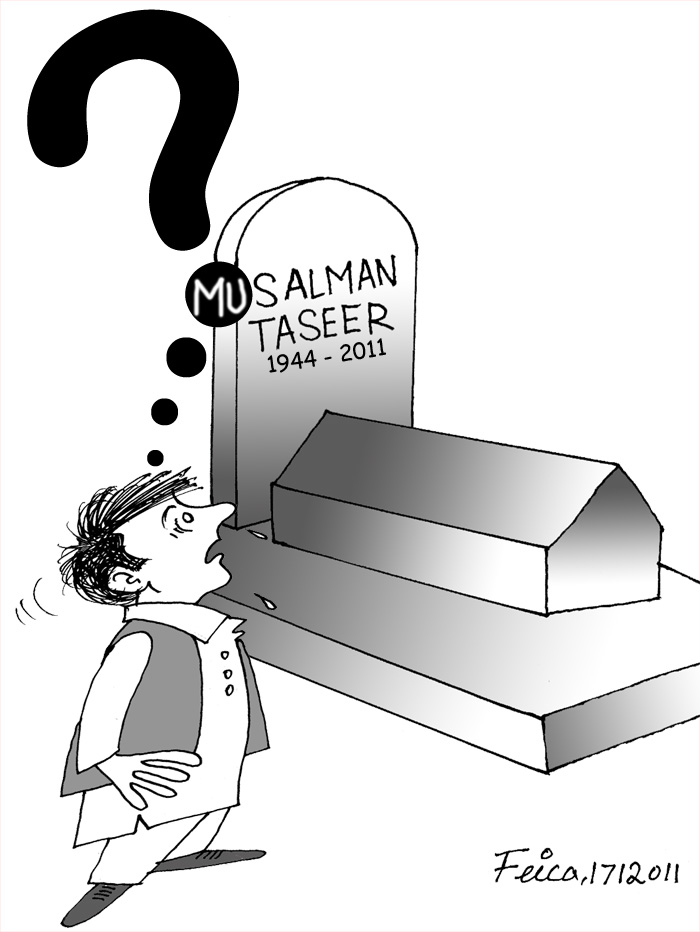

January 4, 2011 Salman Taseer (aged 66) was assassinated in Islamabad by his own security guard Mumtaz Qadri. In an interview with Meher Bukhari on Samaa TV, Taseer commented on his view about the country's blasphemy law which came under fire from different sections of Pakistani society. In the aftermath of his death, a sharp contrast between the ideological division of Pakistan society became apparent. Some called off a Fatwa against attending his funeral and hailed his assassin as a hero. The other group reluctant of expressing their sympathies parted their ways. I rang phone to a personal friend of late governor for condolence and was shocked by the attitude I received.

25 January 2011
Egyptian revolution started
movement began on Tuesday, 25 January 2011 .The uprising was mainly a campaign of non-violent civil resistance, which featured a series of demonstrations, marches, acts of civil disobedience, and labour strikes. Millions of protesters from a variety of socio-economic and religious backgrounds demanded the overthrow of the regime of Egyptian President Hosni Mubarak, who was ruling for more than 30 years.

Despite being peaceful in nature, the revolution was not without violent clashes between security forces and protesters, with at least 846 people killed and 6,000 injured. What started symbolically in Tahrir Square of Cairo, quickly spread to Alexandria, and in other cities in Egypt. On 11 February, following weeks of determined popular protest and pressure, Mubarak resigned from office.

On January 27, 2011,
Raymond Davis
killed two men in Lahore, Faizan Haider, 22 years old and Faheem Shamshad 26 year old. Davis turned out to be a former United States Army soldier, private security firm employee, and contractor with the Central Intelligence Agency (CIA).


The U.S. and Pakistani governments did not agree as to Davis' legal status in Pakistan at the time of his arrest. Claim of him having a diplomatic immunity was denied by the Pakistani authorities. Overnight media coverage turned Davis into a household name throughout Pakistan, and his case was closely monitored and reported. Just when diplomatic efforts from US were appearing to eye any successful in persuading Pakistan for his release, one of the victim; Shamshad's widow, Shumaila Kanwal committed suicide and last words she uttered reflected her hopelessness for any justice be given to her. Pakistan's then foreign minister Shah Mehmood Qureshi also paid a price for denying American claim of Davis' diplomatic status. On March 16, 2011, Davis was released after families of two killed were paid $2.4 million blood money.


11 March 2011, Japanese Earthquake made headlines around the world. Earthquake of magnitude 9.0 approximately 70 kilometres east of the Oshika Peninsula, hit underwater at depth of approximately 32 km.


This also resulted in massive tsunami, which further caused destruction on a second level. The Japanese National Police Agency confirmed 15,844 deaths,5,890 injured, and 3,451 people missing across eighteen prefectures, as well as over 125,000 buildings damaged or destroyed. Around 4.4 million households in north-eastern Japan were left without electricity and 1.5 million without water. Japan declared a state of emergency following the failure of the cooling system at the Fukushima Nuclear Power Plant.

It crippled transportation, destroyed telecom, dams and water, ports, disrupted electricity and gas, and effected Japan's defence and space program. World Bank's estimated economic cost was US$235 billion, making it the most expensive natural disaster in world history. Despite international media and relief workers were not allowed in the country, what we saw was long cues of Japanese people patiently standing to receive basic stuff like water. The courage with which the nation lifted and emerged out of this tragedy, was the most spirited lesson learnt from this disaster worldwide.

22 April 2011 Moin Akhtar
(aged 60) was a Pakistani television, film and stage actor, as well as a humorist, comedian, impersonator, and a host. He was also a play writer, singer, film director and a producer.

We have grown up following his comedy on TV and stages. Akhtar was fluent in several languages, including English, Bengali, Sindhi, Punjabi, Memon, Pashto, Gujarati and Urdu. His fan following spreads throughout the subcontinent and his demise was followed by a national mourning.
His took off from the ever declining stage comedies of 80s & 90s and parted his ways from another comedian Omar Sharif, only to emerge as an iconic talent with a taste for meaningful satire and rich subjects. His legendary place in the entertainment industry of Pakistan, will always be felt with a huge vacuum left till eternity. He was a heavy smoker and died in Karachi after suffering from a heart attack.

May 2, 2011, Monday, Osama bin Laden
(aged 54) was reportedly killed in a US forces special operation, carried out in Abottabad. The news sent a shock wave throughout the world, but ripples it most created was inside Pakistan. Who? What? How? that followed, continued to spray onto minds of almost all citizens for weeks to come. Notably there were more questions left than answers, amid this saga. Osama was buried in sea within hours, and no visual picture of video is produced till date to confirm. Since American president announced the news instantly, Pakistan was only hoping for a peace to follow after the demise of their more feared enemy. Once again several absentee funerals were also reportedly prayed throughout Pakistan.

22 May 2011 PNS Mehran was attacked by militants carrying guns, rocket-propelled grenades (RPG) and hand grenades, killing 13 people, injuring 16 others and blowing up at least two military aircraft.

The dead include 11 navy officials and one Ranger, while two P-3C Orion, maritime patrol aircraft were destroyed within first few minutes of the attack. Not only live footage ran through most the news channels, but also live sounds of gun fires and explosions could be heard throughout the night in many nearby areas of Karachi. It took 14 hours for the security force to finally clear the base of militants. Preparation and tactics of the terrorist was acknowledged by the Naval chief.


(Continued....)

Sunday, November 27, 2011

Have some Respect !

Do not brag about the size, unless your gun comes with balls.

Tuesday, October 25, 2011

Your Villain My Hero


We grew up in an age of wars and global conflicts. Foreign diplomacy weighed by either international assistance or isolation. Where military maneuvers and political alliances go hand in hand.

Old folks tell us about times when there were initiatives drawn on common global interests and ideological identities. Those were times of Zulfiqar Bhutto in my country, King Faisal in Saudi Arabia, Anwar Sadaat In Egypt and Colonel Gaddafi in Libya.

Those were days when these men aspired their people with euphoria from an uncharted dreamscape. Equality, opportunity and above all sovereignty. Where no foreign aggression, occupation or diplomatic pressure could be exerted on individual states. Bhutto packaged "power to the people", while Arafat vowed for independence, Faisal voiced Palestinian Jihad, Qaddafi envisioned Muslim unity and governing reforms, so on and so on.

What happened, then?

  • 24 March, 1975 - King Faisal was assassinated by his nephew.
  • 4 April, 1979 - Bhutto was Hanged after a military coupe in Pakistan.
  • 6 October, 1981 - Sadat was gunned during a military parade.
  • 11 November 2004 - Arafat died in Coma, his illness remains a mystery.
  • 30 Dec, 2006 - Saddam was hanged on Eid Day, after Foreign invasion.
  • 20 Oct, 2011 - Qaddafi vandalized and killed by Libyan rebels.

Today the Body of Libyan revolutionary leader Colonel Qaddafi was laid to rest, before dawn at an un marked placed in Libyan desert.

What started in February was reported to be a public protest in couple of cities of Libya, against Qaddafi rule. Unlike Tunisian and Egyptian spring, Qaddafi used force against those protesters which quickly licensed NATO and US to start operating a bombardment program against Libyan Forces. International reporters were calling it a mere force of 3000 guerrilla fighters, up til few weeks earlier. Not to mention all the aerial bombardment inside Libya which systematically broke the Libyan defense force. Cruise missiles, drone planes, Italian, French fighter jets and bombers, with billions of dollars worth of sophisticated technology that first crippled the Libyan forces. Then city after city these rebels (turned freedom fighters) cleared the areas of any Qaddafi loyalists and supporters. Finally pushed back, in his home town Sirte, Qaddafi breathed his last. Where upon fleeing in a convoy he was bombed by NATO fighter jets, only to be later brutally vandalized and killed by a mob of rebels.


Where have all the good men gone?

______________________________________________________
You may also like to read an old related Blog about Arab Spring:
Hot Pursuit revolt

Sunday, October 16, 2011

Autumn in History


Alexander’s Retreat

[325 BC 120 km Off karachi]

Historical records show that Alexander passed through Khyber Pass region on his expedition into south east Asia, around September 327 BC. Two years later while retreating he passed through Makran Coastal desert in the autumn of year 325 BC.

There are two possibilities, explaining as to why Makran became his choice of passage. Firstly, Alexander chose the Makran desert route towards home, as a punishment to his army who had mutinied in India by refusing to follow him any further East.


Secondly to protect and supply, or be supplied by, the fleet. His fleet of ships was sailing side by side in the Arabian sea. Necessity of the fleet’s voyage along this coast? One reason most often suggested was to open up a sea trade route to India. For that to happen, the coast would have to be charted, landing sites and wells would have to be mapped. Commanding the fleet whose assigned job it was to travel along the coast, would meet with the army at various points, and supply them with grain and provisions. The army’s job, in return, was to provide wells and protection for the fleet whenever it put into shore to take on fresh water.

With the veterans gone and large part of the army sailing along the coast, he yet led 30,000 troops and half as many followers into the furnace heat and sandy dunes of Makran. Across the Hingol River in the desert proper sweet water was hard to find and food even less so. All Alexander’s plans to provision the fleet were failed.

Thirst and hunger raged through the army. When sweet water was reached men threw themselves into it and drank, sometimes dying from the excess. Hunger led others to butcher animals, then, carrying their goods themselves through the sucking morass of sand, they would lay down by the side of the road and die. Wagons broke down and the weak and wives and children unable to keep up were abandoned of their fate. None would stay behind to ease the distress of companions and loved ones, for it was important to get on.

Only half of those who had ventured into the Makran struggled into Pura (Bampur in Iran) two months later. Alexander had succeeded, but at a terrible price.

Thursday, August 18, 2011

Combating Corruption - Anna way

He once wanted to end his life, and even wrote a suicide note which is now referred as a two page essay "on why he wanted to end his life". One day he chanced on a book at Delhi railway station and found that the motive of his life is in service to his fellow humans.

Today, Anna Hazare is the face of India's fight against corruption.

He has taken that fight to the corridors of power and challenged the government at the highest level. People, the common man and well-known personalities alike, are supporting him in the hundreds swelling to the thousands.

His tool of protest - hunger strikes. And his prime target - politicians.

Kisan Baburao Hazare popularly known as Anna Hazare, has fought to eliminate discrimination against dalits or untouchables; a custom laid by caste system in India. He fought against customs of dowry and arranged several collective marriages to make it easy on poor. He faught for the right of rural people in collective decision making in development of villages in India.

He is not new to fighting, he served in Indian army for 15 years. For last 30 years, he is fighting for social change simultaneously in several fronts.

Recently to force government for the implementation of the Jan Lokpal Bill, the anti-corruption bill drafted by his team of crusaders, he planned a hunger strike in Delhi against large-scale corruption at the national level. He and his followers through this bill are demanding a complete elimination of corruption from all government offices and ministries. Through media frenzy his message and fight has gone viral throughout India.

Last Tuesday hours before starting a public hunger strike with thousands of his supporters, 74 year old Hazare was taken by police from his residence to a jail in Delhi for a 7 day detention. This has resulted in public outrage demonstrations and protest throughout India. Could this prove to be a fatal stunt by Indian lawmakers? Only time will tell.

Note:
It wouldn't kill us to follow Indian news even slightly, compared to how we follow Indian cinema.

Friday, July 8, 2011

Thursday, July 7, 2011

Karachi bamboozled


It felt like 38'C. I waited good 20 minutes on a traffic signal. Apparently there was some VIP movement. I remembered, oh the president had to come today. In the end, traffic wardens allowed vehicles back on road and yet there was no motorcade which passed through?

Whoa!

I asked myself, 'Did i miss out on some latest technology?'
An invisible and silent motorcade of protocol cars, security jeeps, ambulance along with at least three or four similar luxuries escorts, how did I not notice all this action?

"Errr@#*(^%$#&^ who gives a flying duck, lets go"... i told myself and moved on.

Same day in the afternoon i came across another of such "ROAD BLOCKS" as i call them. This time i asked the 'itchy pants' policeman who stood beside me on the sidewalk.

"Is it president?"

"may be" he replied as he continued to ...

At the radio, as the evening hours passed me by, i met with people accounting four such security barricades where in two cases nothing passed through in the name of "VIP movement" and on two separate occasions, they reported a high profile convoy of cars.

12:15 in the midnight, while driving back home, i could not get on to Sharae Faisal, again!
Some son of gun had to move, and road was BLOCKED for public.

This time, it was a convoy of security escorts, jeeps, cars and a red flag vehicle along with protocol and ambulances, after which roads were open for public.

My day was rough, so i didn't think much before the bed.

But next day after consulting this with some random listeners on the morning show, i concluded that nearly thousands of us, here in Karachi got bamboozled.

There were tens and thousands of karahiites who had to suffer and wait on multiple occasions due to such road blocks.

"We felt like, being fooled into believing some very high profile person has to pass through, as we waited indefinitely through large traffic stops. and suddenly traffic was allowed back on the road, without having to notice any VIP movement" said one caller in my show.


Is this a new security plan for VIP movement?

Bluffing people?